Why workflow and method modeling is the key
AI is transforming the way companies operate on a fundamental level. It not only streamlines existing processes, but also challenges and disrupts established business models. As organizations integrate intelligent systems into their operations, the boundaries of what is technically and economically feasible continue to shift. This development is particularly evident in the field of engineering, where AI-driven tools and methods are accelerating innovation, enhancing decision-making, and redefining how products and systems will be designed, implemented and validated in the future. In short, AI is reshaping the entire portfolio of tomorrow’s engineering practices.
Roadmap of AI in Digital Engineering
AI offers opportunities for economies and companies. What these opportunities are on the long run depends on the industry sector and its specific pain points of today. In engineering many aspects are discussed as potential AI-supported aspects, such as:
- Self-driven design processes: Autonomous, iterative product design
- Rapid concept generation: Fast creation and evaluation of product ideas
- AI-based simulation & validation: Simulations and testing through AI for efficiency and quality
- Digital twins: Virtual replicas of real products for real-time analysis and predictions
- Human-AI collaboration: Partnership between humans and machines to maximize innovation potential
- Future of technical innovation: Outlook on the next steps in technology development
- Reduced time-to-market: Shortened development cycles and faster product launch
- Adaptive, self-improving systems: Systems that evolve and improve independently
As good as the opportunities with AI sounds there are essential points required to be discussed. Where should a company start today to gain one or more of those AI benefits? Is it a straightforward path? Are there different forms of AI? Who is responsible for the engineering outcomes, human or AI? And many more questions which open up.
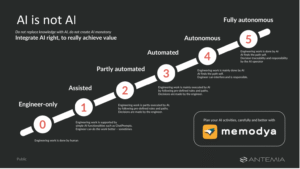
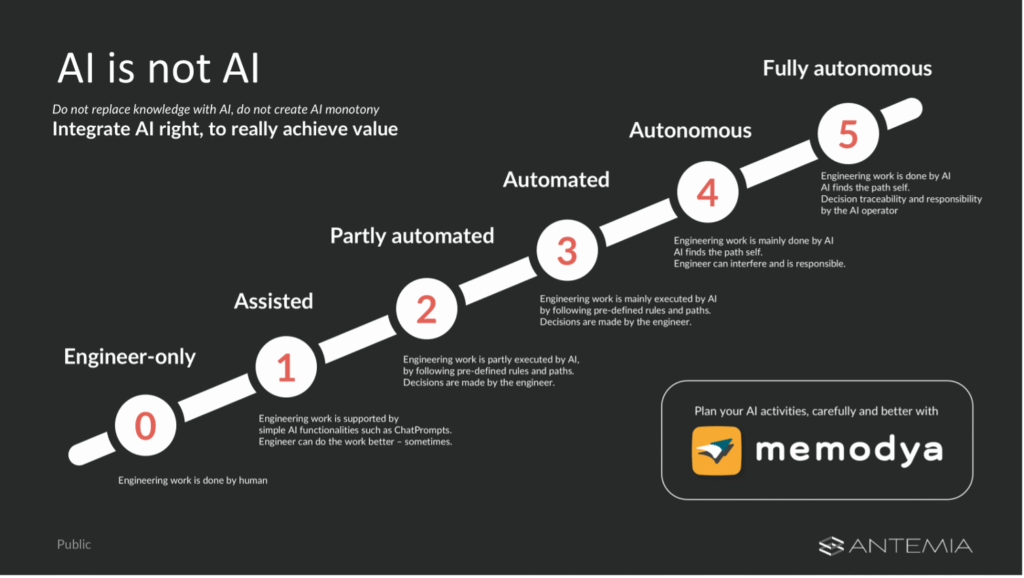
To give an answer to these questions Antemia GmbH designed a roadmap for AI used in engineering:
Level 0 – Engineer-only
Human engineers aren’t supported by AI, they development the product/system; state of many companies today
Level 1 – Assisted
AI provides recommendations and accelerates finding the right information.
Analogy: like a cruise control in a passenger car, AI supports engineers as assistance by providing improved information search in form of chatbots.
Level 2 – Partly Automated
AI manages selected tasks, but human must be ready to intervene. The workflow is defined and monitored by engineers. As example, automated simulations or design checks are supervised by the engineer, or AI-generated design concepts with human review and adjustments. Analogy: Passenger car with highway autopilot.
Level 3 – Automated
AI takes over many tasks under certain conditions; human intervention is possible, but not expected. The workflow is still defined and monitored by engineers.
As example, self-driven, iterative product design where AI automatically generates and tests ideas. Decisions are still made by humans. Analogy: Automated driving in passenger cars, where the driver still has a steering wheel to intervene. The driver is still responsible.
Level 4 – Autonomous
AI operates autonomously within defined environments; human intervention rare and only under certain conditions. The workflow is defined by AI, not by humans.
Analogy: For an autonomous vehicle, the human is only passenger and customer of the delivered service. No steering wheel exists. In engineering, this could be an adaptive, self-improving AI to autonomously designing, testing and producing products.
Level 5 – Fully Autonomous
AI assumes full responsibility; human involvement is not possible.
Example: Fully automated product development from ideation to market launch without human input.
Memodya as Key Element to Implement AI in Digital Engineering
Artificial Intelligence (AI) is a powerful enabler for transforming digital engineering, offering automation, intelligent decision-making, and accelerated innovation. However, the successful adoption of AI in engineering environments requires more than advanced algorithms, and bringing in some AI features and agents. It demands structure, clarity, transparency, and control. This is where memodya becomes a key element in operationalizing AI within engineering workflows.
Memodya provides a structured solution that organizes engineering outcomes, underlying methods, and the AI-related activities. By capturing the context, purpose, and outcomes of AI operations, it makes the integration of AI planable, traceable, and target-oriented. And it specifies responsibilities. Engineers can systematically plan AI use cases, document assumptions, track decisions, and evaluate the performance of AI models across projects. This brings clarity into what AI is doing, why it is doing it, and how its results influence the product development process.
Moreover, memodya enables consistent learning over time. By tracing results, simulations, and historical insights, AI can reuse knowledge from previous projects and continuously improve its predictions and design proposals. This creates a closed-loop engineering environment where data flows seamlessly, and AI becomes a dependable part of daily engineering tasks rather than an isolated technology experiment.
By combining AI’s computational power with memodya’s structured knowledge backbone, organizations can shift from ad-hoc AI experiments to a systematic and manageable approach. Memodya lays the foundation for scalable, transparent, and efficient AI deployment, ultimately enabling more intelligent digital engineering processes.
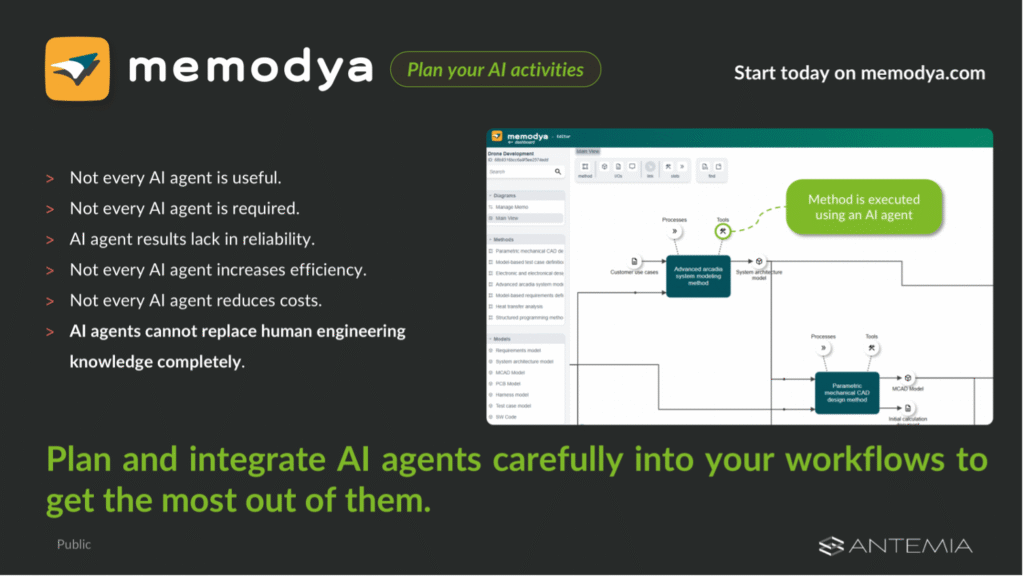
Memodya empowers engineering teams to work together efficiently and to implement AI purposefully. Whether you seek basic AI assistance or fully autonomous, AI-powered development platforms, memodyatransforms your methods and processes into living, reusable assets. It centralizes knowledge, enables real-time collaboration, and aligns tools with workflows, accelerating your move from manual design to adaptive, self-improving systems.
Don’t get left behind.
AI is transforming engineering processes, accelerating innovation, and drastically reducing time-to-market. No matter what level you are at, memodya guides your journey.